WEM Interviews CJ DeBarra
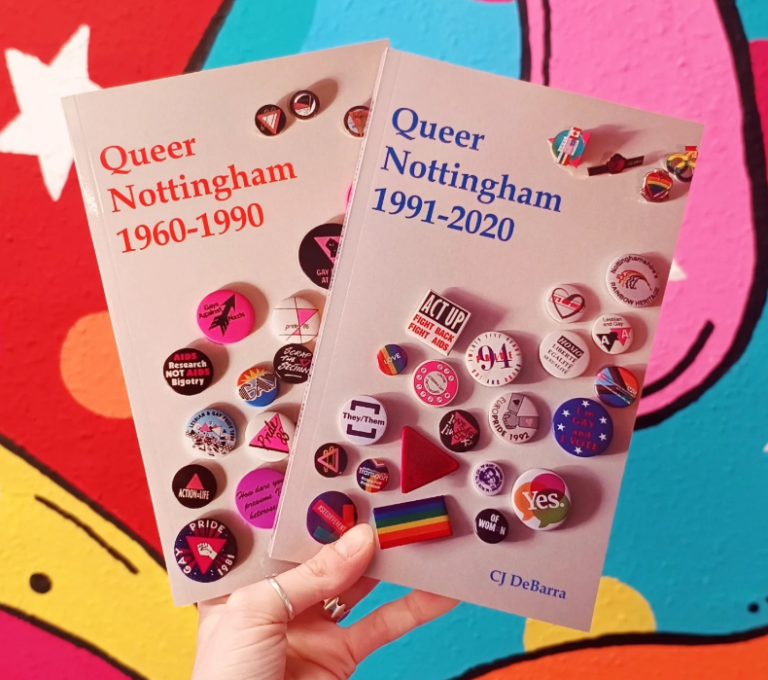
Nottingham LGBT+ Historian, CJ DeBarra talks all things hidden histories, queer happenings in Nottingham's past and their new book, 'Queer Nottingham 1991-2020'.
Ever wondered what queer life was like where you live? Maybe you’ve daydreamed about the local LGBT+ legends who might have shared your postcode, the Starbucks that was once your community’s go-to gay bar, or the places of protest that you now pass on the way to work.
Lucky for Nottingham residents, there’s no need to wonder! CJ DeBarra is the queer and nonbinary journalist, author and historian connecting Nottingham’s queer community and its allies with our shared past. As the author of the Queer Nottingham trilogy, and as the founder of the Nottingham Queer History Archive, they work tirelessly to recover Nottingham’s lost LGBT stories.
With the recent launch of volume number two in the trilogy, Queer Nottingham 1990 – 2020, we caught up with CJ to talk about research, missing history and Nottingham’s very queer past!
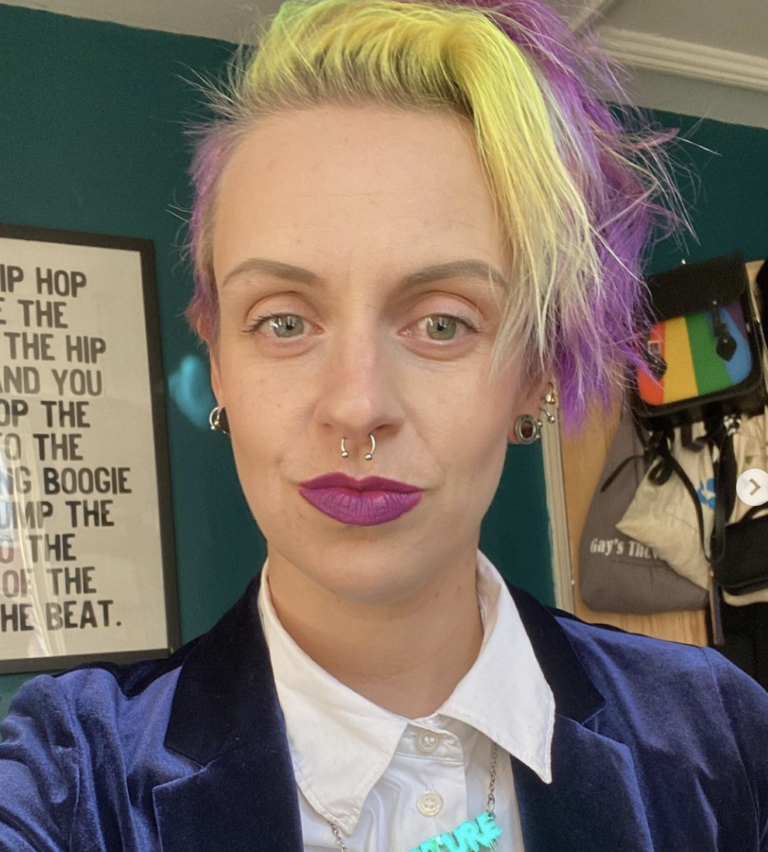
Congratulations on the launch of volume number two in the Queer Nottingham trilogy! To start off our questions, could you tell us a little bit about the driving force behind the entire project? What motivated you to start?
I used to work in local news reporting and one day I was sent to interview Debbie Law as she retired from running the New Forester’s pub, which is the longest running LGBT+ space in the UK. She told me about all the wonderful history of the pub, and I was intrigued to find out more, so I started researching. As a journalist, I spent my life collecting people’s stories, so it was natural to me to turn to oral history to gather information. Three years later, I have 200 interviews done with LGBT+ people aged 18 to 93 and no plans to stop. The motivation has always been the same as it has been with journalism – the desire to know more.
Was there a significant difference to your approach and your subsequent findings between volumes one and two? Which did you prefer writing?
There is a bigger difference between Vol one and Vol 2 to vol.3. Volume 3 examines 1770 to 1965, which meant I no longer had oral histories to weave into the stories. I had to rely on my research skills, which meant that it could, at times, be very difficult. It also meant much more travel, as many of the stories required seeing archives in Hull or Cambridge. I am very proud of what I achieved with it. In Vols. 1 and 2, the chapters are organised by decades chronologically. In Vol. 3, it’s much more story-based so where I have found evidence of queer life, I’ve written about that decade in detail. I loved all three, but I have a soft spot for vol.3 because it was a new challenge.
What is your personal approach to research? How did you go about finding people to interview and choosing what to include in the final draft?
I was lucky that Nottingham has a solid queer history kept by excellent historians such as David Edgeley, Chris Richardson and Mo Cooper. I could use their work to find names, then approach people from there or research further. As a journalist, when it came to oral history, I knew a great quote when I got one, so it wasn’t hard to find things to include – harder to exclude quotes as so many were excellent.
In the research volume, I had so many incredible stories that I knew instantly what I wanted to include. Although there were some excellent stories that I didn’t have space for, which broke my heart. It may have come down to space in the end that some stories didn’t have enough information available. In one case, there was a woman I was interested in, and still get major queer vibes from, but ultimately, I had no evidence to say she was a lesbian and didn’t want to include just on the off chance that she might be. Someday, I may revisit it and hopefully find something that would mean I could include her!
A lot of your research comes from oral history, acquired through interviews—over two hundred people! How do you account for memory or differing accounts, especially when collecting so many testimonials and piecing them together?
I would back things with research as much as possible where I could. People are always going to remember things differently so its about having that understanding to allow them to do so. What I would do, is if I had two conflicting accounts, is that I would refer to a more emotional layer of people’s stories in the books. That’s the stuff I can’t research and find factual evidence for – I would be able to say a nightclub existed from 1973 to 1977, but I want to know how someone felt when they went there. So by focusing on those details rather than the factual ones in oral history (but still allowing people to tell me factual stuff!), for the book, it bypassed any major disagreements – that I know of!!!
What was the most interesting/shocking thing you discovered in volumes one and two?
I was particularly delighted by the discovery of trans histories that hadn’t been included in our queer histories before, especially the stories from the 1960s and 1970s. It was wonderful to find the story of Joan from Beeston, who transitioned after the war, and I am delighted to have a copy of her diaries in the archives that outline her life story. Stories like hers and, indeed, Paula, the star of a 1970s film that was shot in Nottingham (All Women Are Equal by Margaurette Paris, 1972) show that trans people have always been here and part of our scene.
Was there anything that resonated with you personally?
The stories around HIV/AIDS resonated with me personally, as I used to be a sexual health outreach worker in the 2000s-2010s. I’ve always had a big interest in HIV/AIDS history, but it was moving to work with so many people whose lives were affected by this. In 2024, I brought panels of the UK HIV/AIDS quilt that related to Nottingham back to the city for the first time since they were made here in the 1990s. That felt like a big moment, and also, it was incredibly moving to see. I’m very grateful to Body Positive East for allowing me to do that and helping me to get it here.

Now that volumes one and two have been published, it’s time to start on volume number three! What aspects of queer history between 1790 and 1960 are you most interested in learning about? Can you give us a glimpse of anything you’ve learnt so far?
I think the war years were particularly fascinating. I am really fascinated by ordinary lives – how people lived, where they went, what life was like for people back home, not on the battlefronts and those who were. In a queer history sense, this meant having to piece together scraps of stories, older oral history accounts and also, research that had been done that accidentally revealed snippets of LGBT+ life. I got really, really lucky that in my research, I was able to find several men with ties to Derby and Nottingham with incredible stories, and one trans woman’s story from World War II.
Another area I was fascinated by was the music hall era, as Nottingham had some legendary halls, including Malt Cross. I found stories of gender bending performances, lesbian fan-girls, and drag kings or ‘male impersonators’ as they were then. I was excited to learn that queerness in some way or form has been with us for a long time!
Lastly, if you had to choose one assumption you’d like potential readers to unlearn about Nottingham’s queer history, what would that be?
That our history is the same across the country. Often, when we hear about queer history, it’s filtered through London, so we pick up stories of Polari (usually presented as ‘the queer language’; it’s a mix of Romani, Italian, Irish, and carnival slang), Molly houses, and the West End. In fact, I found a real mix with Polari in that not many people spoke it in Nottingham, even less fluently. I want people to unlearn that there is one queer history but start asking what that looks like for their city: how did queer people use the caves?
Did Nottingham, as a big mining city, have a Lesbians and Gays Support the Miners campaign? (Yes!), Or have we ever had an LGBT+ sheriff (also yes!) Or even, was Robin Hood himself queer? Let’s start talking about queer histories unique to us to start creating a larger tapestry of what it looks like for England.
ABOUT CJ DEBARRA
CJ DeBarra (they/them) is queer, non-binary journalist, author and historian from Cork, Ireland residing in Nottingham, UK.They are the author of Neuroqueer (Mercier Press, 2023) and Queer Nottingham volumes one and two (Five Leaves, 2025).CJ is also the founder of the NQHA, an oral history campaign recording queer stories from Nottingham spanning from 1770 to 2026.
Pre-order your copy of ‘Queer Nottingham 1991 – 2020’
Follow CJ’s work:
Website | cjdebarra.com
Instagram | @cjdebarra