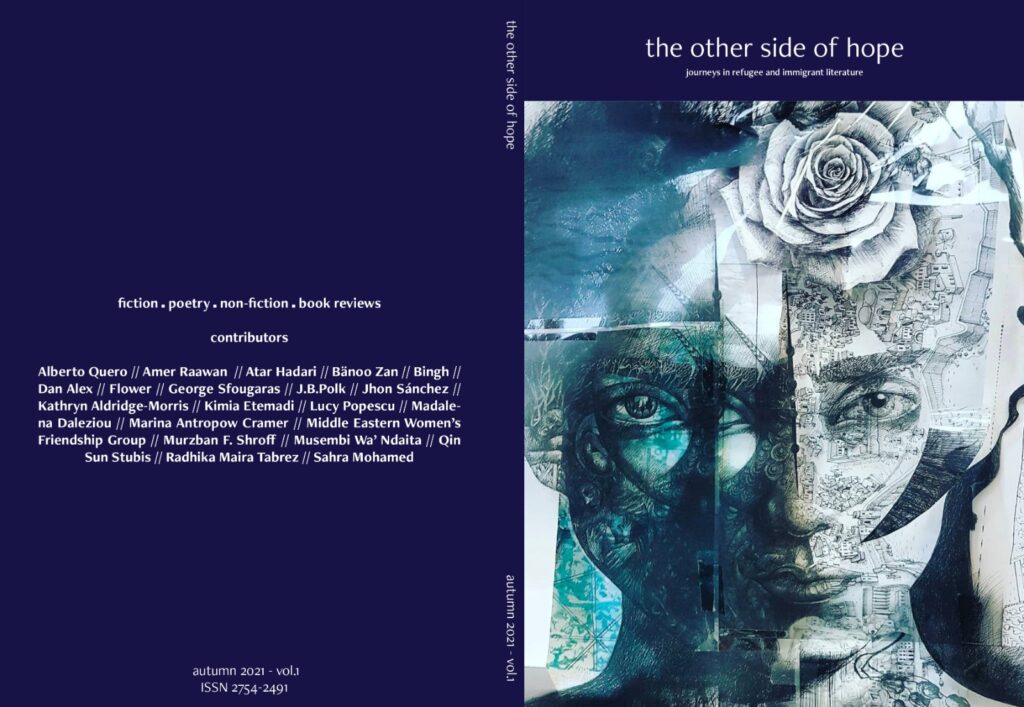
the other side of hope: journeys in refugee and immigrant literature has published its first online and print magazines with the work of 120 writers between them. Now available to read in both formats, the magazines feature fiction, poetry, and nonfiction from immigrants and refugees, existing to serve those communities worldwide.
Its founding and lead editor, Alexandros Plasatis, has previously worked with Writing East Midlands as a lead writer for WEM’s Write Here: Sanctuary project. Throughout the project, over 260 individual refugees and asylum seekers in Nottingham, Derby and Leicester took part in bespoke writer-led programmes with a view to increasing confidence and to create a sense of wellbeing and inclusion for the participants.
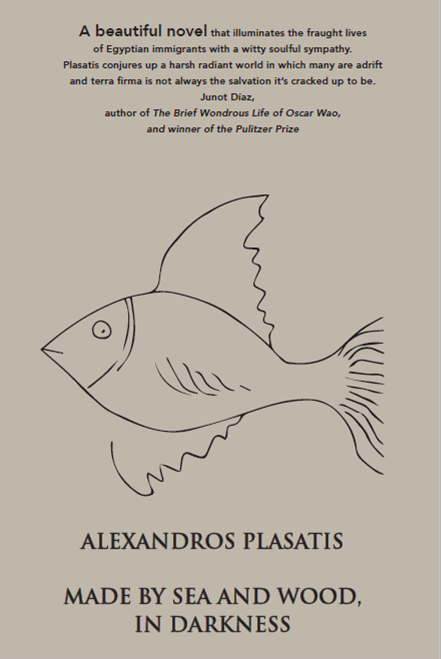
Alexandros is an immigrant who writes fiction in English, his second language. His first book, Made by Sea and Wood, in Darkness: a novel in stories (Spuyten Duyvil, 2021), was shortlisted for the Edge Hill Prize. Stories from this book have been nominated for the Pushcart Prize and Best of The Net.
His work has been published in US, UK, Indian and Canadian magazines and anthologies. He has a PhD in ethnography-based Creative Writing, lives in Bolton, and works with displaced and homeless people.
After the release of the other side of hope, we had the privilege of talking with Alexandros about his work with refugees, the Sanctuary project, and his journey to publication.
Have you always been interested in other people’s stories? What about them interests you?
AP: I always listened much, much more than I talked because I always felt I don’t have anything interesting to say and because usually I don’t have the need to talk. When I truly listen to someone telling me a story, I feel warmth, and the person who’s narrating is my god. I prefer to set up my temples in the margins because that’s where I feel comfortable and I can be myself.
My gods are usually people who are frowned upon, they are gods with scars, they are sinners, they can be unjust, they use ungodly words, but, if you listen, and listen again without judgment, you’ll find their truths, who they really are. The journey of understanding, through stories, men and women who are misunderstood is wonderful, I feel cleansed and more human when the journey comes to an end. For me, listening to people’s stories is an adventure under hard shells of misfortunes and bad luck.
What initially drew you to working with refugees?
AP: The poems of Nikos Kavvadias. Kavvadias didn’t write about refugees, he was a sailor and wrote about the life in the ships and the places he visited, and the people in his poems were strange sailors from all over the world. His poems drew me into wanting to get to know people from different cultures and admire their beauty. Kavvadias’s poems first led me into exploring the lives of the Egyptian men who worked as fishermen in Greece, and later, when I moved to the UK, this exploration led me to working with refugees.
How has your work as lead writer for the Sanctuary project influenced your direction as a writer?
AP: That project influenced the direction of my life. After the project I became a volunteer at a refugee centre, I worked for a refugee festival, then I worked for a charity and lived for two years in a house with young unaccompanied asylum seekers – my job was being their father.
Most of my friends are refugees now, many of whom were participants in that project. I had never thought I would do these things. And then I created this literary magazine, the other side of hope, which is a wonderful journey so far. If that initial project with WEM will influence my direction as a writer, it will depend on whether one day I will stop being lazy and write about all these experiences.
What was your fondest memory from the project?
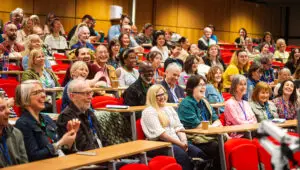
AP: When we were invited to a poetry evening, an open mic event, and these people with limited English, with trembling hands and tremors in their voices, walked up there, one by one, and stood in front of the audience and read their poems. And their smiles afterwards, the wonderful smiles of people who have done something that they thought they would never be able to do.
the other side of hope is edited by refugees and immigrants with the aim to serve those communities through words. Why do you feel it is important that these communities can shape their own representations?
AP: I don’t like the idea that only the immigrant should write about the immigrant, only black people must write about black people, and so on. Writing is about freedom, and everyone should be able to write whatever they want to write.
One of the reasons that the entire team consists of immigrants and refugees is because we want to prove that we can do things well. We lack opportunities and this magazine gives opportunities: refugees and immigrants learn the editorial side of things, and migrant writing is being published and showcased.
Because we as editors are also writers who write in our second language, I think we are good at understanding writing that comes from people like us, I think we are good at seeing beyond a piece of writing, at what the writer intended to write, and sometimes we can work with them to bring that intention to the foreground.
Being immigrant editors, we also have more understanding in some writers’ need to criticise their own culture. A piece that to you might seem politically incorrect, to us might simply be a writer’s truth and their need to express it.
The most challenging aspect, and most rewarding, is to not think as a writer, to liberate yourself from the oppressive thought that you are a writer, and dance in the rhythm of words that were said by others.
Alexandros Plasatis Tweet
Both the other side of hope, and your debut novel, Made by Sea and Wood, in Darkness, use collections of short stories that connect to form a broader picture. Do you find that short stories are a more effective vehicle for your writing goals than longer pieces?
AP: I didn’t plan for Made by Sea and Wood, in Darkness to be a novel-in-stories or a short story cycle. I wrote one short story about a fisherman friend, then another story about another fisherman, and so on. I knew that if I continued writing, I would have something between a short story collection and a novel, and I was fine with that. Maybe I did it this way because at the time I was reading many more short stories than novels or maybe because my mind works this way.
Could you describe the process from seeking agent representation to publishing your debut novel?
AP: After I finished writing the book, I borrowed that big red book from the library, the Writers’ and Artists’ Yearbook. I wrote a cover letter that I was okay with and began emailing literary agents that I thought might be interested in my kind of writing. In the US they read more short stories than in the UK, so I approached more US agents.
One of them liked what I had sent her, asked for the full manuscript, said she loved it, we talked over the phone, and she offered representation. At the time there were a handful of other agents who had asked for the full manuscript, so I notified them I had an offer (that’s part of the etiquette, and it’s good to follow it). We exchanged lots of emails with the agent, and through this exchange, I realised that when agents say that they must fall in love with what they represent, they mean it.
The agent cracked the book’s shell of hard and raw language and inside it she saw what I had seen in the lives of these beautiful Egyptian men. But things didn’t work out. She tried the big publishers and though we got close, we didn’t get close enough. So, after a while we parted ways and I will always be grateful to that woman who believed in the book and tried. I was on my own again, and approached indie publishers myself, and the small and historic New York publisher, Spuyten Duyvil, brought the book out.
Made by Sea and Wood, in Darkness takes inspiration from stories you heard in real life. What would you say is the most challenging aspect of working with factual accounts?
AP: I lived these stories, not only heard them. The book is based on ethnography and lived experience. I was there for years, doing the things they did, taking notes and interviewing. The most challenging aspect, and most rewarding, is to not think as a writer, to liberate yourself from the oppressive thought that you are a writer, and dance in the rhythm of words that were said by others.
Do you feel that Made by Sea and Wood, in Darkness is more a blend of fiction and reality, rather than biography?
AP: I think it’s more of ethnographic fiction than anything else.
You can order your copy of the other side of hope here, and find out more about Alexandros’s book and short stories here.
For more information on WEM’s Write Here: Sanctuary project, click here.