ABOUT THE AUTHOR
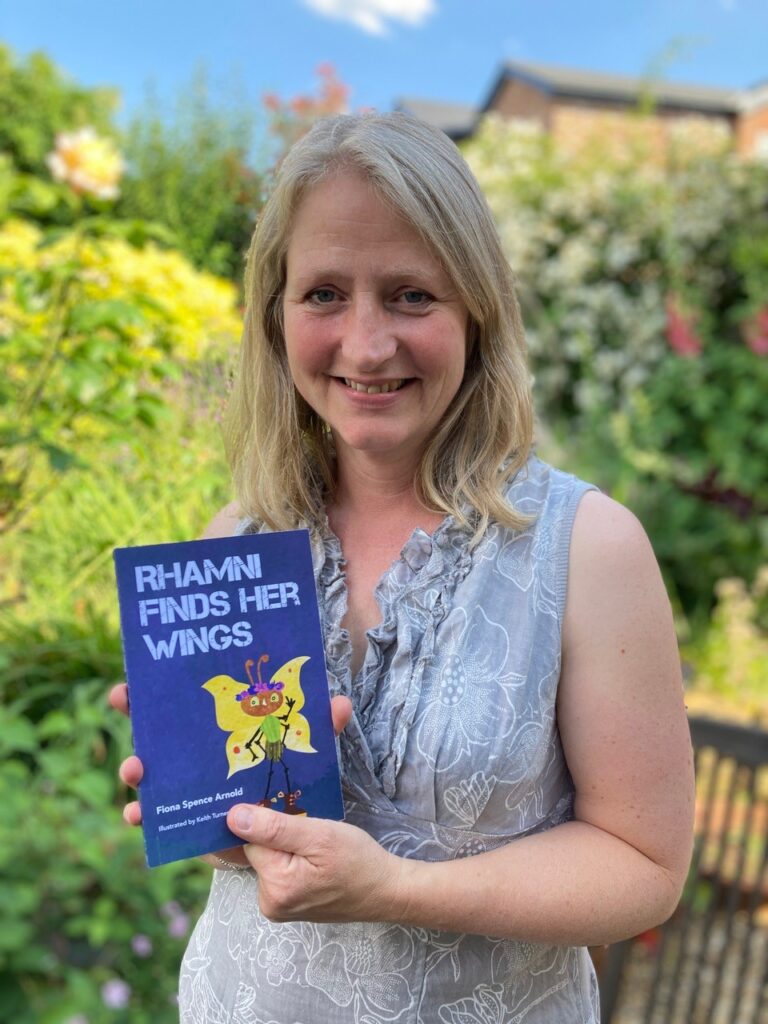
Fiona Spence-Arnold is a Leicestershire-based children’s author. Her recent debut novel, Rhamni Finds Her Wings, is published by Honey Craft, and you can find this here. She also works on education projects for an award-winning charity and helps to run a small family video production company.
In 2020, Fiona was offered a place on the Writing East Midlands Mentorship Scheme and was matched with children’s author Ally Sherrick, supporting her time travelling adventure novel, The Time Heist. It was longlisted in December 2021 for the Bath Children’s Novel Award, and in July 2021 for Guppy Books open submission competition. You can find out more about Fiona’s experience on the 2020 Mentorship Scheme by clicking here.
In addition to her new novel, she has had a short story for children published by Glittery Literary and her chapter book, Edie Edison and the Impossible Invention was shortlisted for the Write Mentor Novel Award in March 2022.
Back in 2023, we caught up with Fiona for some insight into her experience on our free writer development programme. This year, the Mentoring Scheme opens early for its 2027 cohort of applicants. Submit your writing by 5th August 2026 to be considered.
Congratulations on your first published novel! Could you walk us through your publication journey so far?
FSA: Thank you! After years of writing, the process of having a book published was actually really quick. An email dropped into my inbox in February 23 from an organisation, Mantle Arts, who I had done several writing masterclasses and events with previously. They’d been approached by Honeycraft.org, an independent publishers based in Leicester, seeking a children’s writer with a connection to The National Forest. I jumped at the opportunity, living nearby to the forest, and with a love of nature, I applied. I was so excited to win the commission to write a colour illustrated chapter book for children aged 8 – 10, about butterflies and moths in the National Forest, as part of their MiniBEAST series.
From March onwards, I collaborated with the team of Creative Director, Liga Orlovska, illustrator, Keith Turner, Editor, Jess Green and Entomologist, Graham Smith. We had several online meetings where Graham shared fascinating butterfly and moth information. I began my own research. The characteristics of the insects and their habitats inspired the story and the characters themselves. For instance, Graham told us about a group of butterflies who used to be known as the Aristocratic Butterflies – these include the Red Admiral and Purple Emperor. It inspired me to imagine a hierarchy in the forest led by the antagonist, Emperor Ethelbert, a Purple Emperor butterfly who tries to wield power over all butterflies and moths.
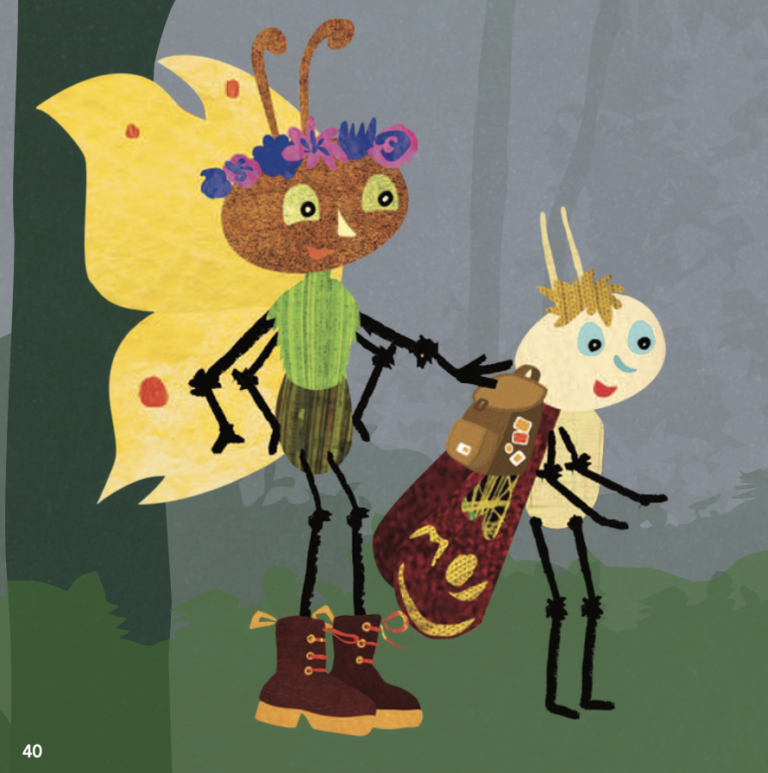
Working with Editor and Writer, Jess Green, I produced an outline, synopsis and pitch quite quickly, and within a couple of weeks, the first draft. We shared this as a team and Keith began to think about the illustrations he would create. He asked me to think of an accessory for the main characters that would be a short cut for their characteristics. I gave Rhamni, a Brimstone butterfly, big, stompy boots as she’s adventurous and quirky, and Max, the Mint Moth, a back-pack as he’s quite sensible.
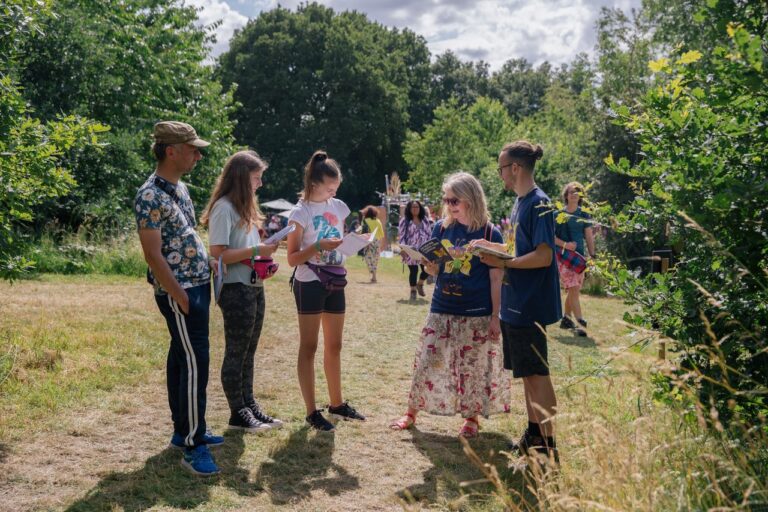
From start to finish, I wrote the drafts in approximately 6 weeks and delivered the final draft in May. As part of the project, I was also paid to run a writing workshop with children and Graham, the Entomologist, at Snibston Country park in April and another at the Timber Festival in July, where, excitingly, we had the book launch.
Has the experience been what you expected to be? What did you find the most surprising?
FSA: The experience was a lot quicker than I expected, but this was maybe because I was working with an independent publisher who probably has more freedom to set their own time frames for publication.
I absolutely loved researching and creating the book, working with such a lovely team. Creating books truly is a collaborative experience, from sharing drafts, bouncing ideas around and providing support for one another. I was bowled over when I saw the wonderful illustrations Keith created. For instance, for Tig, a Golden Pygmy moth caterpillar, Keith brilliantly had him painting a ‘Mona Lisa’ with a leaf. Keith uses collage in his illustrations, and he told me if you look closely at the moon in one of the pictures, it’s actually an image of grated cheese!
What was the most challenging part of the publication process?
FSA: The quick turnaround for the illustrations and layout of the book to be approved was challenging for me and the illustrator. The book had to go to the printers in time for the initial launch at the Timber Festival in July. We only had a couple of days to approve it.
But equally challenging, I found, is the shift I had to make from writer to publicist and salesperson. It uses quite different skills and I’m still getting the hang of it now! Fortunately, I attended a Debut Bootcamp online in June with my children’s author society, the Society of Book Writers and Illustrators (SCBWI) which was amazing. It was full of helpful, practical advice from published authors, who volunteered their time, publishers, librarians and fellow debut authors.
Following on from that, I joined a group on Twitter for debut children’s authors and this has proved invaluable to me to know I’m not the only one with these challenges or experiences. I would definitely recommend signing up for something similar if you are lucky enough to get published. Publishing is a different world and you need all the support and help you can get. Find your writing friends and hold them close. They get it and will be your most wonderful champions and friends.
What originally drew you to children’s writing?
FSA: I had always loved reading as a child and being read to by my parents. The chance to visit other worlds and imaginations was wonderful. I also always loved writing and would spend hours creating my own books.
When I was teaching in my late 20s, I rediscovered children’s fiction and became aware of its power to enrich and entertain young lives and to encourage lifelong readers. Then, when my own children were young, the pleasure we all got from sharing books each day inspired me to pick up my pen again and create my own stories.
I started to create stories for them, but soon began to work on my craft more seriously. I signed up for courses specifically for children’s writing, back when my youngest child was about three. He’s 18 now, so it has taken 15 years to get my first book published.
Before Rhamni Finds Her Wings, you wrote The Time Heist and Edie Edison and the Impossible Invention. What would you say has been the most difficult stage of writing a novel and why?
FSA: I’ve also written several more books over the years that will almost definitely remain firmly in my ‘drawer’. Weirdly, each book had its own slightly different challenges and for each I tried out new ways of planning, plotting, developing characters and stories as I learnt from the previous one. I’d say I now plan much more thoroughly than I used to. Starting with a pitch, that I try to get to the heart of the story, lots of research, character development, the synopsis and a rough outline before I start on the actual writing. This process can take a lot longer in the initial stages, but hopefully it saves time in the edits.
I absolutely love the research and the first plans, getting into the characters and what makes them tick, and then my absolute favourite part is writing the first draft, just for me. When it comes to the subsequent drafts and editing process, that’s the part I find the most difficult. I think it’s the closeness to the characters and how the story has evolved that I find difficult to change. Although, this is the part that always makes the story better.
How did your time on the Writing East Midlands Mentoring Scheme support your writing journey long-term?
FSA: Working with Ally Sherrick on the Mentoring scheme supported my writing in so many ways. The level of detail in her constructive feedback on my work and her coaching to get to the heart of my story has stayed with me in the books and stories I’ve written since. She was so generous in sharing her research and writing processes that I was able to compare, consider and use them to inform and develop my own processes.
The mentoring also helped boost my confidence in my writing immensely, including giving me the confidence to enter competitions like The Bath Children’s Novel Award and Guppy Books Open submission competition. Which in turn, further boosted my confidence and saleability when The Time Heist was listed and subsequently gained positive interest from agents too.
Equally as important, is the network of support from Ally and from other new writer friends that she introduced me to. Writing and getting published is a difficult, long process and having writer friends who get it and are there to champion each other’s work is vital.
Ultimately, the mentoring gave me the confidence to think that I was on the road to publication – it might not be a straight road, or very short, but I knew if I kept creating, kept working on my writing craft and kept being open to opportunities, I would arrive there eventually! Not that it’s the end of the road. Now the challenge is to build a career, one step at a time.
Incidentally, when I worked with Jess Green, in her capacity as Editor for Rhamni Finds Her Wings, (Jess is also a poet and script writer,) she was impressed to hear that I’d done the WEM mentoring scheme. As she said, it was impressive as it’s hard to get onto. So, I do think the kudos that comes with having done the Mentoring Scheme helped me longer term too.
What was the most useful piece of advice from your mentor?
FSA: Ally’s advice on finding the heart of your story and ramping up the drama and emotion to reveal this is always in the forefront of my mind when I start a new book. It may change as the characters reveal their story but keep this central to your work and your reader will be emotionally engaged in your story too – hopefully!
Do you have any advice for writers applying to the Mentoring Scheme this year?
FSA: Go for it! Don’t hesitate. The work you have is good enough. They’re not expecting a finished book, you wouldn’t need the mentoring if it was. Be open to new ideas, be open to learning, be positive and enjoy it. You get a published author to work on your book with you, to take your writing seriously, to offer support and knowledge – what’s not to love?
Also, big tip, if you don’t get through on the first attempt, try again! I think I applied three times with different stories over several years, until I made it on the scheme. You can too.
You can find out more about Fiona’s most recent publication and stay up to date on her writing journey through the links below.